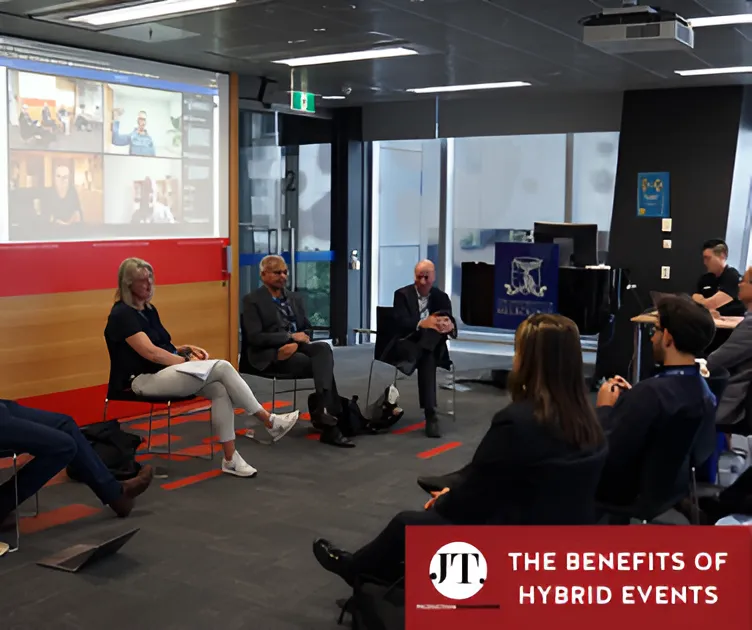
5 benefits of running hybrid events
Hybrid events have moved well past their pandemic-era origins. What began as a stopgap during lockdowns is now a first-choice format for many national and international organisations, and often the smarter answer for events that used to default to in-person only.
Hybrid delivery brings together the best of both worlds. It carries the energy and connection of a live room, and it adds the reach, technology, and data of a well-designed online experience. When it is done well, the in-person and online audiences feel like part of the same event, not two separate ones.
What is a hybrid event?
A hybrid event is a lot more than a webcam and microphone in the corner of the room.
At its core, a hybrid event runs online and in-person components simultaneously, so people can join the celebration, collaboration, or learning from wherever they happen to be. There is usually a physical location (event HQ) where the organisers, hosts, and key stakeholders are based, and where the bulk of proceedings are broadcast from. Selected guests attend on-site. The remaining audience, often the majority, joins through a purpose-built online event platform.
The online experience should offer more than a passive video feed. Attendees expect to view the programme, ask questions, chat with other guests, network in dedicated rooms, and interact with polls, quizzes, and live activations. Our own Future Events Lab platform is built around exactly this kind of two-way engagement.
Content is a mix of live and pre-recorded, including speeches, panels, videos, entertainment, games, and interactive segments. Some events even coordinate home delivery of meals, gifts, or event packs to online attendees, so guests wherever they are feel considered from the moment the event begins.
When it is designed properly, hybrid should not feel like a compromise. It should feel like a better version of the live-only original.
Five reasons to go hybrid
1. Increased attendance and reach
Going hybrid means more people can and will attend. Whether the barrier is distance, cost, an illness or family emergency, a scheduling clash, or caring responsibilities at home, hybrid gives those people a way to participate. Instead of 150 guests in one city, you can reach hundreds, or thousands, nationally and internationally, all around the same programme.
For organisations with a genuinely national or global audience, hybrid removes the “who has the budget and freedom to travel” filter that traditional events silently apply. Our case study on Innovate 4 Cities (UN-Habitat) 2024 is a good example of what this looks like at scale.
2. Better for the environment
The fewer people travelling, whether by air, car, or otherwise, the smaller your event’s carbon footprint. For organisations with sustainability commitments, hybrid is one of the highest-impact levers available.
You can feature an international keynote without flying them in. You can reduce single-use products (bottled water, printed programmes, notepads) simply because there are fewer people on-site. Venue energy costs (lighting, air conditioning, catering) all fall in step with reduced attendance. Combined with thoughtful supplier choices, the impact is real. For more on this, our post on sustainable event merchandise covers the wider sustainability picture.
3. Smarter use of budget
Hybrid does not automatically mean cheaper, and anyone who tells you otherwise is oversimplifying. But it does open up smarter uses of your event budget.
Room hire, catering, and on-site staffing all scale down with fewer people in the room. That saving can then be redirected into the online experience, or into higher-value speakers you might not otherwise be able to afford. The online platform, streaming production, and remote support are genuine line items that need to be budgeted from the outset. Anyone who tells you they are trivial is not costing hybrid honestly. For more on the specific costs event organisers overlook, our post on the 6 hidden costs event organisers always miss goes deeper.
4. Variety of content
Nobody wants to attend an event just to watch a video. But at a hybrid event, that expectation is naturally recalibrated. Guests know to expect a combination of formats: live-streamed sessions, pre-recorded segments, interactive online components, and in-room moments.
That variety makes the event more dynamic, and it gives you more control. Pre-recorded content lets you edit for quality, remove risk from complex segments, and make sure your most important messages land exactly as intended. Live content brings the energy and interaction that only real-time delivery can carry. Balanced well, the two formats amplify each other.
5. Data, insight, and content that keeps working
This is the benefit most first-time hybrid clients underestimate.
A live-only event is a one-day performance. A well-produced hybrid event is an ongoing content asset. Recordings can be released as on-demand sessions in the days and weeks afterwards. Standout moments can be recut for social. Keynotes can be repackaged into industry articles or podcast episodes. Sponsors get more visibility over a longer window, not just on the day. For a broader look at how this feeds into event marketing strategy, read our post on Event Marketing: Turning Moments Into Momentum.
The data side matters just as much. Modern event platforms generate structured data on registrations, session attendance, engagement, poll responses, and content downloads. That insight is gold for planning the next edition, refining your audience segments, and demonstrating ROI to internal stakeholders and sponsors. In-person-only events can capture some of this, but nowhere near the depth or reliability of a proper hybrid platform.
Get the design right and hybrid delivers
Hybrid works when it is designed as a hybrid event from day one, not as a live event with a stream bolted on the side. The room and the screen need to be treated as two audiences with different needs, not one audience delivered two different ways. That is the mindset shift that separates good hybrid from awkward hybrid.
For a look at what commonly goes wrong when this isn’t done properly, our post on 4 common hybrid event mistakes to avoid is a useful companion piece to this one.
Since 2013, JTPM has delivered more than 1,200 events across Australia, and a significant number of them are hybrid or fully digital events with attendees and speakers spread across time zones. We have seen what works, what does not, and what actually delivers value for the money spent.
Ready to design a hybrid event that actually delivers?
If you want the reach of online with the connection of in-person, hybrid is likely the right format. Our team at JTPM offers full-service Melbourne event management services and Australia-wide delivery, including digital events, conferences, and hybrid award ceremonies under one roof.
Book a design session with us, or get in touch to start the conversation.