6 ways to go green at your next event!
At JTPM, we treat sustainability as a design choice on every event, not an add-on. Reducing environmental impact is now something clients ask about before we finalise a design, and rightly so. Every event carries a carbon footprint, and the choices you make in the planning phase are what determine whether it is a large one or a small one.
The good news is that going green does not mean less. In our experience, it usually means smarter decisions, better supplier partnerships, and events that guests actually feel proud to be part of. Here are the six areas we work through with clients who want their next event to leave a lighter environmental footprint.
For deep-dives on specific parts of the sustainability picture, our posts on sustainable event merchandise and choosing the right event venue cover the detail. This post is the broader framework the two sit inside.
1. Hire the right partners and suppliers
If reducing environmental impact is a genuine business goal, your event tender needs to reflect that. Include sustainability requirements and preferences as part of the selection criteria from the beginning, not as a soft nice-to-have to be raised later.
Working with event partners and suppliers who share the same commitment is the fastest way to hit (and often exceed) your sustainability targets. Ask suppliers direct, specific questions:
- Where do the materials come from?
- What happens to unused stock or waste after the event?
- What percentage of energy or resource use is offset or renewable?
- Do they have a documented sustainability policy?
Suppliers who cannot answer these questions clearly are usually the wrong choice for a green event, regardless of price.
2. Choose the right venue
There are plenty of genuinely green venues around Melbourne and across Australia, and more emerge every year. Look at:
- Natural light and airflow. A well-lit, naturally ventilated space reduces the need for electric lighting and air conditioning through the day.
- Renewable energy. Some venues run partly or fully on solar. Ask.
- Energy-efficient lighting and heating. Where you cannot avoid electric lighting or heating, look for LED and modern efficient systems.
- Waste management. Composting, recycling, and food-waste programmes matter as much as the fit-out.
Location matters as much as building specifications. A venue that is easy for your target audience to reach reduces the total distance travelled across all attendees, which is one of the largest single carbon costs of any event. That leads directly into the next point.
For a full checklist on venue evaluation, see our post on 10 things to consider when choosing your event venue.
3. Encourage public transport and shared travel
Unless your event includes on-site accommodation, guests are going to travel to reach you. That travel is usually the single biggest contributor to an event’s carbon footprint, especially for anything with a national or international audience.
A few reliable levers:
- Choose venues with strong public transport access. Trains, trams, and buses beat individual cars for both emissions and attendance.
- Consider free shuttle buses between key locations (hotels, airports, satellite venues) for larger events.
- Communicate transport options early and often. Include public transport instructions in pre-event EDMs, on the event website, and on signage. Attendees who plan for public transport are much more likely to use it than those who see the option for the first time on the day.
- Consider a hybrid or online element for attendees who would otherwise fly domestically or internationally. Our post on the benefits of running hybrid events covers this in more depth.
For events that move between cities or run as a national roadshow, our JT Travel team handles the delegate travel logistics, and building sustainability into that piece is a natural conversation.
4. Go paperless with digital invitations and programmes
Just about everyone has an email address and a smartphone. QR codes are now normal, not novel. There is no longer a strong reason to print event invitations, tickets, programmes, or maps at scale.
Digital invitations, e-tickets, event programmes, and interactive maps hosted on a dedicated event platform are cheaper, greener, and more useful. Attendees can search, zoom, filter, and update as the event changes. Our Future Events Lab platform hosts exactly this kind of digital content, with interactive event mapping built in.
We even created event maps out of recycled coffee cups once, helping to reduce the huge number of coffee cups that end up in landfill each year.
If you do need to produce hard copies for a specific reason (accessibility, VIP guest experience, printed collateral for sponsors), use recycled or FSC-certified paper stock as a baseline.
5. Source local and reusable products
Local and sustainable suppliers exist for just about every event input: food, beverages, tableware, furniture, room décor, and merchandise. Seasonal, locally sourced produce beats imported almost every time on both environmental and quality grounds.
Wherever possible, avoid single-use products. A branded reusable water bottle handed to guests at registration is genuinely useful, reduces plastic waste, and doubles as marketing for months afterwards. Water stations beat pallets of bottled water.
If your event is annual or recurring, leave the year off your signage, banners, and other reusable collateral. You can then use them again next year rather than replacing them each edition.
For a much deeper look at sourcing sustainable event merchandise, including working with social enterprises and Indigenous-owned Australian brands, see our post on 3 tips for more sustainable event merch.
6. Offset your event’s remaining footprint
Despite the best planning, some emissions and waste cannot be avoided. Carbon offsetting is not a replacement for reducing impact in the first place, but it is a legitimate tool for the residual footprint of a well-designed event.
The process runs in three steps:
- Calculate your total event emissions. Travel, energy, catering, and waste are the largest categories. A specialist can help if the event is large or complex.
- Choose an Australian offsetting programme or accredited revegetation project. Look for programmes accredited under recognised standards. Local projects also carry stronger co-benefits (biodiversity, community, employment).
- Consider offering guests the option to offset their own travel as part of the ticket purchase. Airlines and rail operators offer this at checkout; your event can do the same.
Offsetting is a supplement to reduction, not a substitute for it. Done well, alongside the other five tips, it gets you to a genuinely low-impact event.
Going green does not mean doing less
Reducing environmental impact does not mean smaller, quieter, or less impressive events. In our experience it usually produces smarter, better-designed events with stronger supplier partnerships and genuinely proud attendees. It is also a story worth telling in your marketing, and one that resonates with an audience that increasingly expects it.
Since 2013, JTPM has delivered more than 1,200 events across Australia, and sustainability is now part of nearly every design conversation we have with clients. Getting it right is a matter of discipline, not budget.
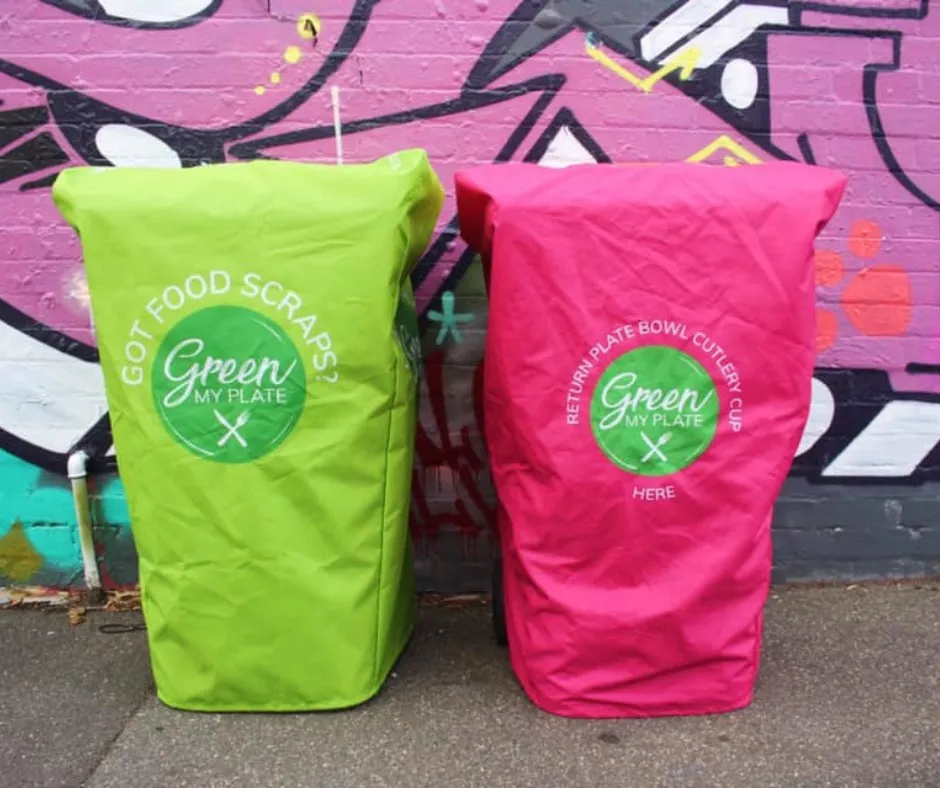
Thanks to Green My Plate, suppliers of reusable plates, bowls, and cutlery, wash stations, and compost bins for events, whose images appear throughout this post.

Ready to plan a lower-impact event?
If you would like a hand designing a more sustainable event across every dimension, from partners and venue through to transport and offsetting, our team at JTPM offers full-service Melbourne events management and Australia-wide delivery, including event management, digital events, and PCO support under one roof.
Book a design session with us, or get in touch to start the conversation.